, ,

Vionnet Patterns

Written by

·

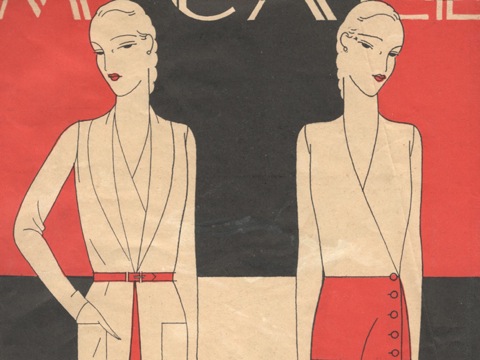
McCall Style News March 1931 detail showing Vionnet sewing pattern
Detail, McCall Style News, March 1931.

The reputation of Madeleine Vionnet (1876-1975), the brilliant innovator in draping and the bias cut, has only increased with time. The label she founded in 1912 was recently revived, and Betty Kirke’s book is back in print for the house’s 100th anniversary. You can see Vionnet pieces online at the V&A and the Costume Institute. There’s even an animated video on Vimeo demonstrating the construction of one Vionnet dress. (For more on Vionnet, see Lisa’s Coletterie post; Betty Kirke’s 1989 Threads article; and Sandra Ericson’s revised 2010 Threads article, in pdf here.)
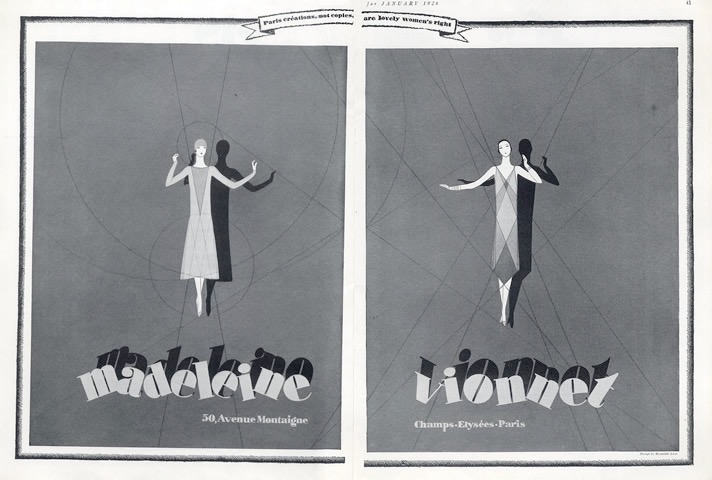
Reynaldo Luza Vionnet advertisement, 1926
Vionnet advertisement, 1926. Illustration: Reynaldo Luza. Image: HPrints.

In recent years, those who wished to reproduce a Vionnet design could trace their pattern from a book. Janet Arnold’s Patterns of Fashion 2: Englishwomen’s Dresses and their Construction, c. 1860-1940 (Macmillan, 1982) includes five Vionnet patterns, and the Japanese companion volume to Kirke’s book (Bunka Fashion College, 2002; available on amazon.co.jp) contains tested, traceable versions of twenty-eight of Kirke’s Vionnet patterns. Costumer Koshka has made the 1919 Vionnet dress in Patterns of Fashion, while the Vionnet Identique project saw all the designs in Kirke’s book made up in half-scale for an exhibition and book (for photos see this Threads post and the book preview).

Madeleine Vionnet label, circa 1930.
Label from an evening cape by Madeleine Vionnet, ca. 1930. Image: Metropolitan Museum of Art.

In the 1920s and 1930s, dressmakers could sew Vionnet designs using commercial patterns. McCall’s released patterns based on Vionnet originals, while companies like Pictorial Review sold adaptations of Vionnet designs. Here is a selection of Vionnet patterns.

These two patterns for a negligee and day dress date to 1926. The negligee is reversible:

1920s Vionnet pattern for a reversible negligee, McCall 4467
McCall 4467 by Vionnet (1926) Reversible negligee.
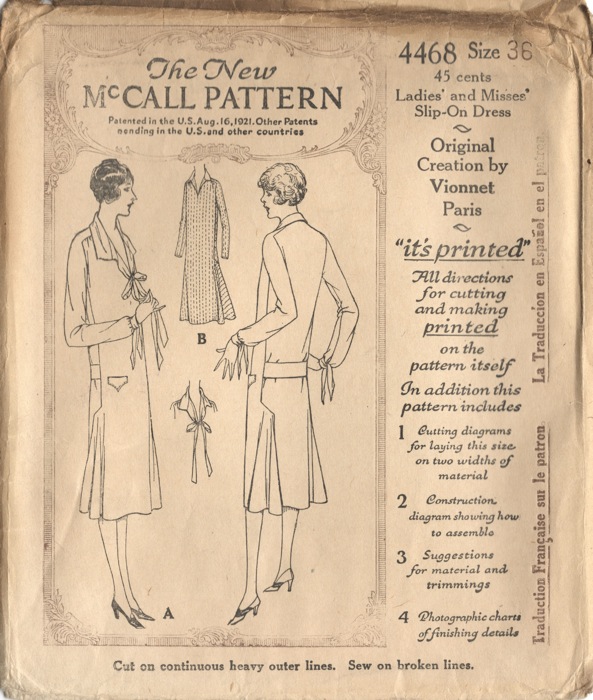
1920s Vionnet pattern for a long-sleeved day dress, McCall 4468
McCall 4468 by Vionnet (1926) Dress.

Vionnet was known for her robes à mouchoirs, or handkerchief dresses, like this evening dress:
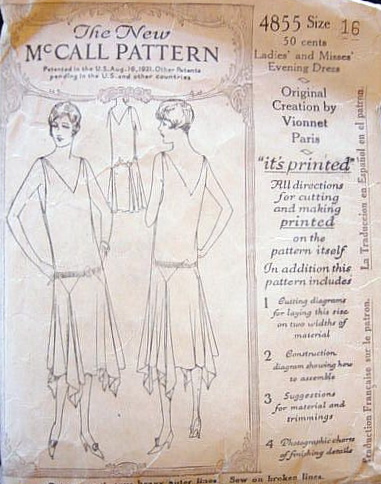
1920s Vionnet pattern for a handkerchief evening dress, McCall 4855
McCall 4855 by Vionnet (1927) Evening dress. Image: eBay.

This formal dress is another handkerchief dress. Note the triangular sleeve insets:

1920s Vionnet pattern for a formal handkerchief dress, McCall 5635
McCall 5635 by Vionnet (1928) Dress.

Here’s a magazine illustration of McCall 5635 from the following year. The accompanying text reads, “A Vionnet gown characteristic of the graceful new formal frocks is simply made to fall in points at the center front and at the sides and back”:

Vionnet pattern illustration in McCall's magazine, April 1929
Illustration from McCall’s magazine, April 1929.

Both McCall’s and Pictorial Review released patterns for this circa 1931 ensemble:
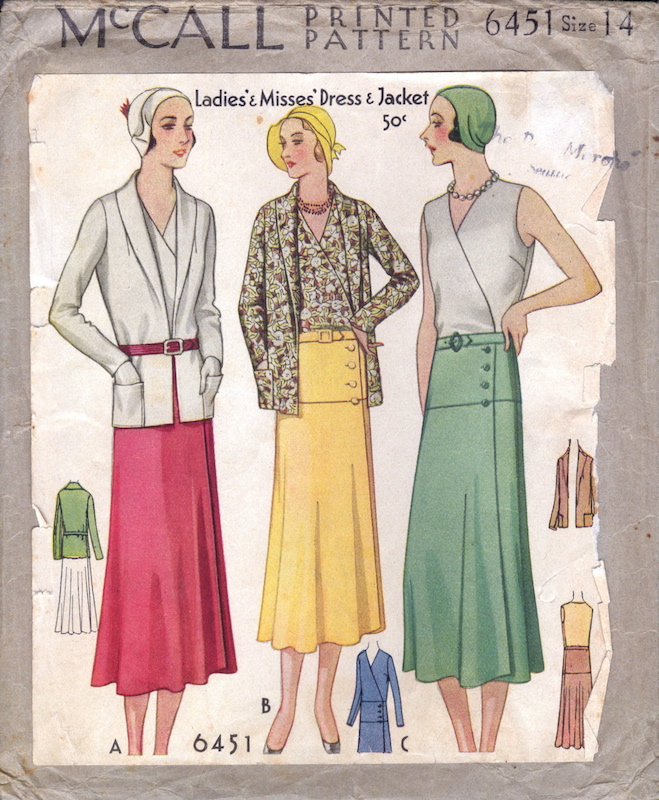
Early 1930s Vionnet dress pattern - McCall 6451
McCall 6451 by Vionnet (c. 1931) Image: eBay.
1930s Vionnet adaptation pattern for a dress and jacket, Pictorial 5592
Pictorial 5592 adapted from Vionnet. Pictorial Review, June 1931.

McCall’s magazine showed two illustrations for this design (McCall 6451); the text on the first page reads, “A masterpiece in simplicity that only Vionnet could have created. The chic contrasting bodice top is sleeveless and joins the skirt in a coat-dress closing”:
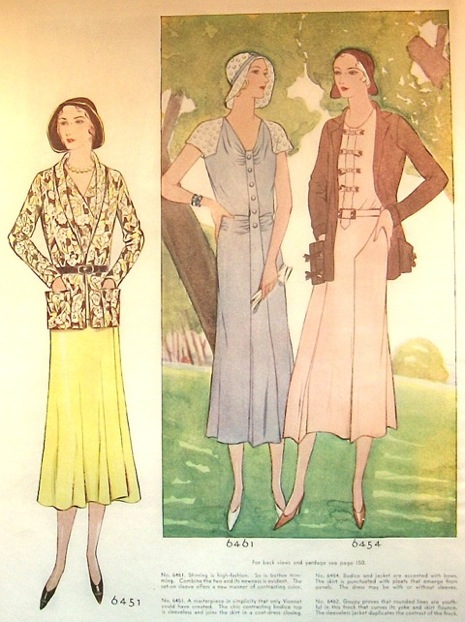
1930s Vionnet illustration in McCall magazine
McCall’s magazine, 1931. Image: Etsy.
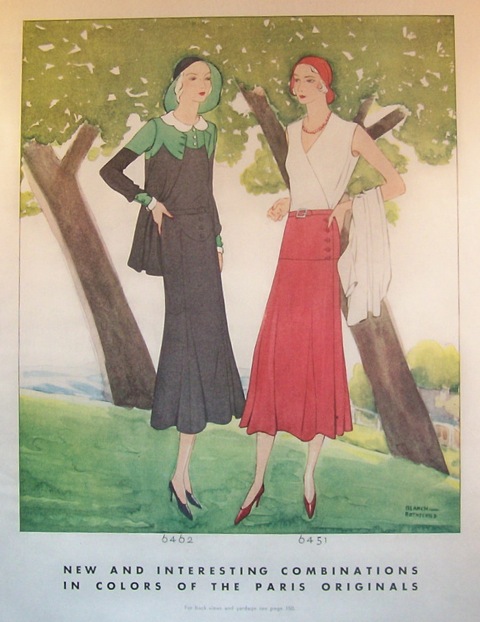
1930s Vionnet illustration in McCall magazine
McCall’s magazine, 1931. Image: Etsy.

The ensemble was also illustrated on the cover of McCall Style News shown at the top of this post. Here’s the full illustration:

1930s Vionnet McCall 6451 illustration on the cover of McCall Style News
McCall 6451 by VIonnet, McCall Style News, March 1931.

This 1932 Pictorial Review design for an asymmetrical day dress was adapted from Vionnet. The skirt and applied front are cut on the bias:
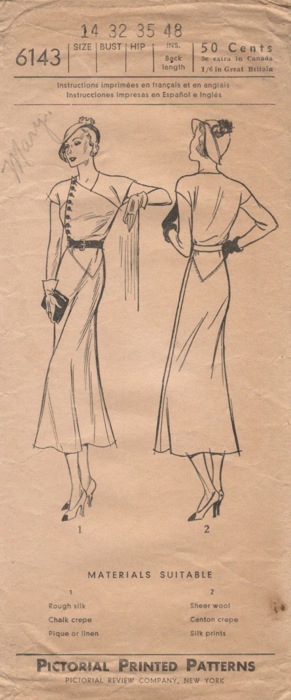
1930s Vionnet adaptation dress pattern, Pictorial 6143
Pictorial 6143 adapted from Vionnet (1932) Dress.

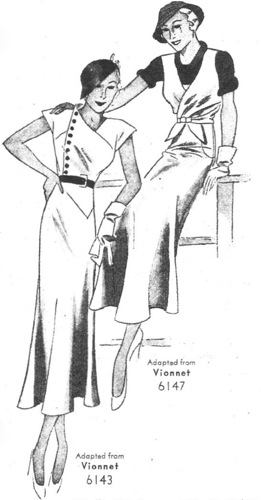
Here’s the corresponding illustration in Pictorial Review magazine. The accompanying text reads, “Yes, it’s a Vionnet, we knew you would recognize it in the characteristic handling of the diagonal seaming, in the clever use of button trimming, and in its absolute simplicity. Make it in a sheer linen with contrasting button accents”:
1930s Pictorial Review Vionnet illustration, Pictorial 6143 and 6147
Pictorial 6143 and 6147, both adapted from Vionnet. Pictorial Review, July 1932.

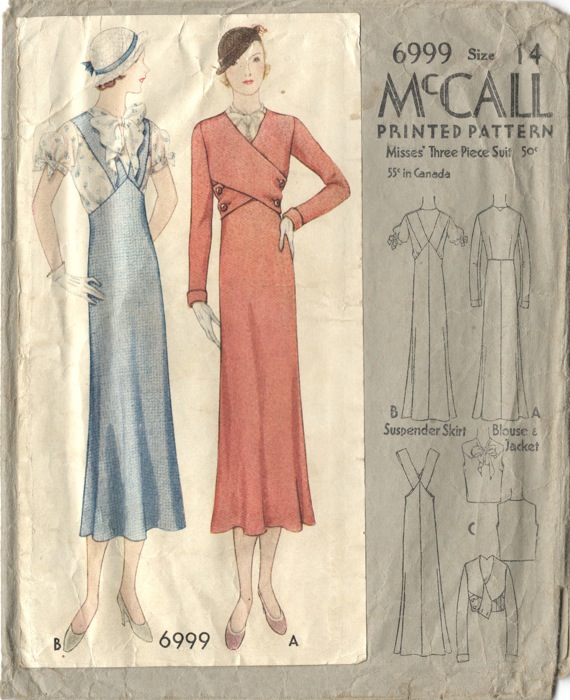
Finally, a three-piece suit pattern from the same year, consisting of a short-sleeved blouse, high-waisted suspender skirt, and jacket that criss-crosses in the front:
1930s Vionnet suit pattern, McCall 6999
McCall 6999 by Vionnet (1932) Three piece suit.

This illustration for McCall 6999 accompanies a trend report on suits:

1930s Vionnet illustration from the McCall Fashion Bi-Monthly
Illustration from the McCall Fashion Bi-Monthly, July-August 1932. Image: carbonated on flickr.

And if you’d like to try your hand at some Vionnet-style fabric embellishment, the Center for Pattern Design sells a pattern for Vionnet roses.

Madeleine Vionnet is said to have considered herself a “geometrician”; the brilliance of her technique reveals itself in her garments’ construction. Have you tried making any Vionnet designs?

20 responses to “Vionnet Patterns”

  1. reretro Avatar

    an absolutely fascinating post. the images are so gorgeous- makes me want to try a pattern (although 21st century self would hardly fit the 1920s ideal.) and great commentary – unpacking the ideals behind the images…thanks!

  2. renata perito Avatar

    I haven’t sewn any vionnet design yet, but I made a paper mock up of her spiral dress – it’s amazing! I am glad to know Kirke’s book is back on print. Thanks for the wonderful post!

  3. theperfectnose Avatar

    Sweet, thanks for all the link-you’ve obviously compiled a lot of research effort here-on an aside, the Japanese book doesn’t have traceable patterns-they’re grided i.e. you have to enlarge them manually/ by scanning and vectorisation.

  4. Heather Lou Avatar

    That diagonally seamed dress is making my mouth water!

  5. puu Avatar

    thank you as always for an informative and inspirational post. i just scoured the internets for a copy; in addition to amazon.co.jp, it is available through etsy seller pomadour24 (as of this comment, 14 dec 2012).

    1. PatternVault Avatar

      Awesome, thanks for this, Devra! It’s going on my wishlist..

  6. stirandstitch Avatar

    wow, stunning illustrations and designs! it’s nice to know the back-story on this amazing designer, whose images i’ve always admired.

  7. Dorine Avatar

    Thank you so much for this post- so inspiring!

  8. Becky bushbunny Avatar
    Becky bushbunny

    Your illuminating presentation of Mme. Vionnet’s work is wonderfully well done. Thank you. As always, your research is thorough, organized and interesting.

  9. Tina Sutherland Avatar

    This was fascinating, I learned so much!
    Thanks for gathering all this together and sharing.

  10. PatternVault Avatar

    Wow, thanks, everyone! I’m so glad you enjoyed my research-in-progress.

  11. Alana Avatar

    I really love the last look pictured… the one on the right.

  12. Petite Main Avatar
    Petite Main

    Great research, thank you so much. And here http://pinterest.com/pin/381328293418916748/ you’ll find another Vionnet-inspired frock which is Pictorial Review 5627

    1. PatternVault Avatar

      Glad you enjoyed it! Thanks for the link. Your Pinterest looks a lot like my iPhoto 🙂

  13. rubyfoot Avatar

    totally and utterly fabulous

  14. […] Vionnet, Schiaparelli also saw commercial sewing patterns for her designs in the interwar period, released […]

  15. […] by Madeleine Vionnet, the book presents a method of sewing bias-cut garments that minimizes sewing on the bias. Diagonal […]

  16. elledechene Avatar

    Such an informative article, thank you for sharing.

  17. […] Soeurs garments survive, and the house is best remembered for its role in the early career of Madeleine Vionnet. But in 2015, the New Yorker published an article on a collection of Callot Soeurs dresses found […]

  18. […] to interiors. In terms of Art Deco fashion and textiles, visitors will find haute couture by Madeleine Vionnet and Jeanne Lanvin, Sonia Delaunay and Marguerite Pangon, together with designs for textiles and […]

Leave a reply to rubyfoot Cancel reply

This site uses Akismet to reduce spam. Learn how your comment data is processed.