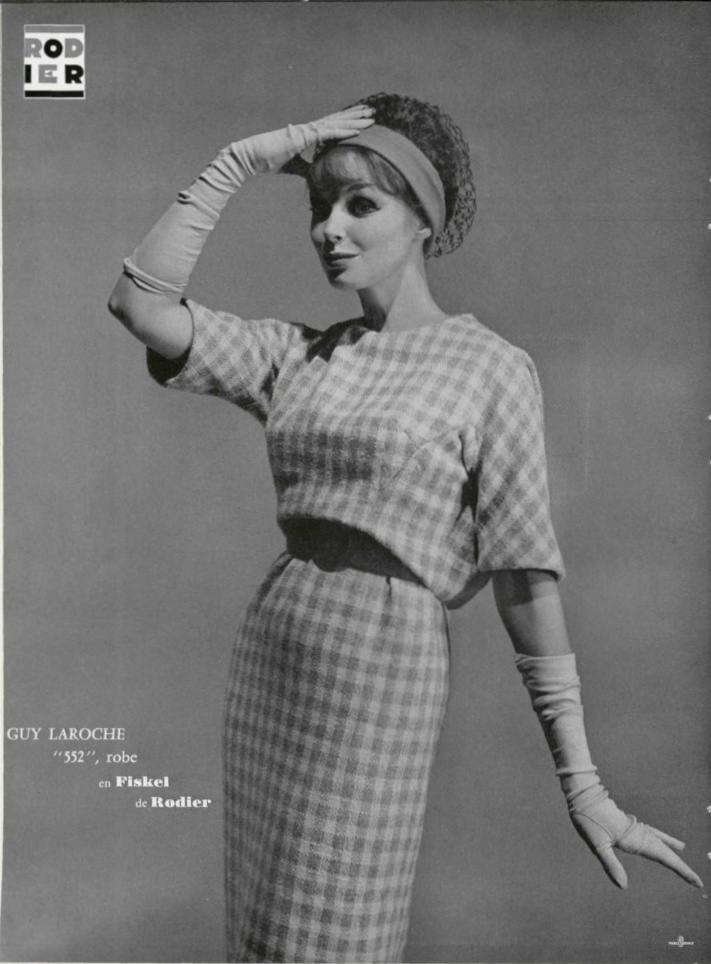
If you’ve ever recognized an old sewing pattern in a contemporary fashion editorial, you may have wondered about the relationship between the designer originals and their licensed, pattern versions. In the late Fifties, Dorothy Roe, women’s editor of the Associated Press, wrote a wire story about just that. “How French Couturiers Reach U.S. Dressmakers,” which appeared in newspapers in August 1959, details how Vogue produced its designer patterns.
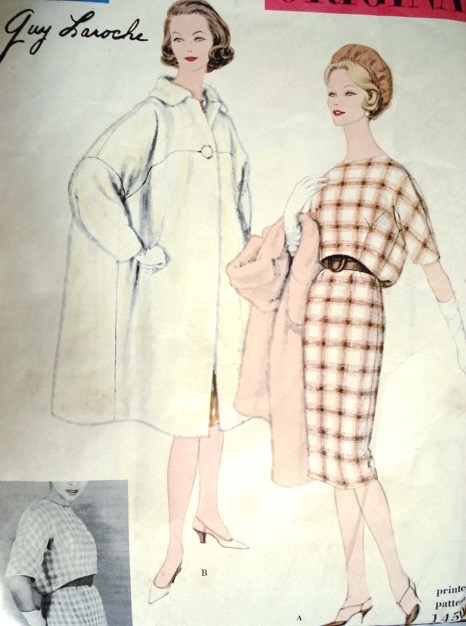
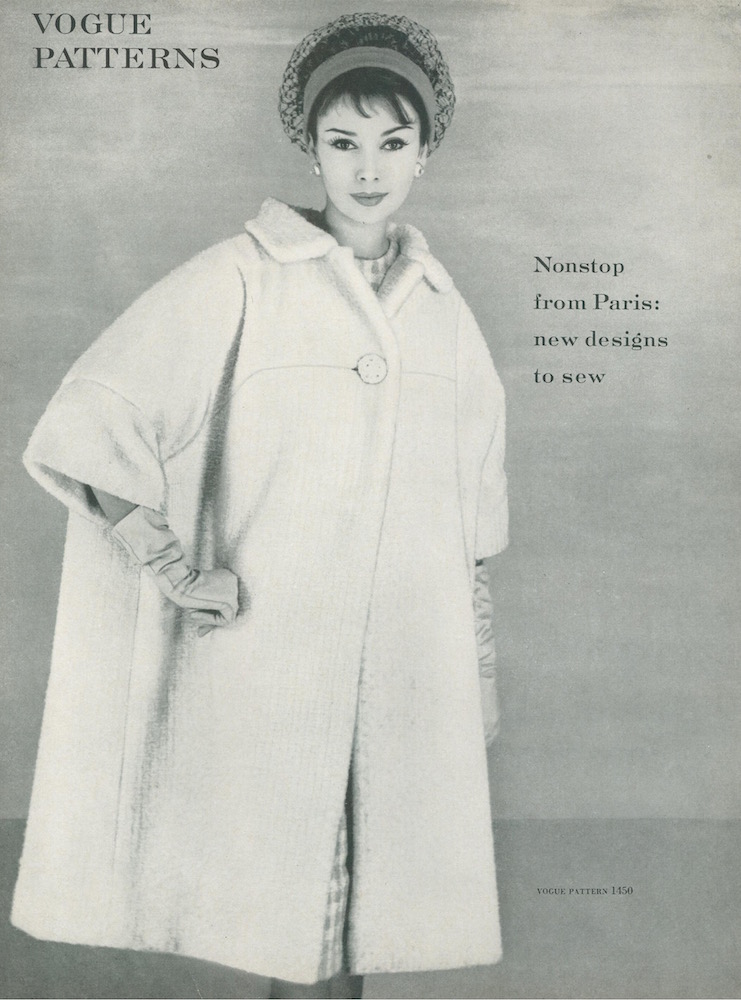
Roe follows one design from Paris salon to pattern envelope, taking as her example “one of this season’s most popular styles, a blouse-back sheath of sheer checked wool, designed by Guy LaRoche [sic], now available to home seamstresses as a Vogue pattern.” The pattern also includes a full coat with a deep yoke. Although she doesn’t mention the number for the pattern, we can identify it as Vogue 1450:
The process begins at the January opening of Guy Laroche’s spring collection, where the audience—press, buyers, and Vogue Patterns’ designer—is seated on gilt chairs in the couturier’s Paris salon. As she views the collection, the designer for Vogue Patterns selects the dress-and-coat ensemble for style and ease of construction by home sewers. After the presentation she negotiates her order with Monsieur Laroche.
The couture house soon sends the order, “carefully guarded and expensively bonded,” to Vogue’s headquarters in New York City. Inside this valuable parcel is a toile, a muslin copy of the selected design that is “complete in every detail, including inner belts, buttonholes, linings, facings, hems and trimmings.” The parcel also includes a set of muslin pattern pieces marked with all the details of construction.
According to Roe, adjustments were made to the French design for the American market: “Since the proportions of the French figure are different from that of the average American, a new muslin is made to conform to American measurements. Every piece of the original Paris pattern is reproportioned, and the new muslin is made as carefully as the original.”
Finally, a cardboard master pattern is made from the new muslin. After the master has been meticulously checked for accuracy, it is used to produce the tissue pattern for Vogue’s new Laroche design. Envelopes and instructions are printed, and Vogue 1450 is ready to ship.
Roe concludes by noting the higher price and difficulty level of Vogue Paris Original patterns. The reward, however, is producing a convincing copy: “Many women planning their first Paris home-sewing project go for help to local sewing centers to be sure of professional work. But with the detailed directions on the pattern, most women experienced in sewing can soon learn to turn out Paris copies which can fool the experts. And what fun it is to say to friends—‘Oh, this is a Paris original!’”
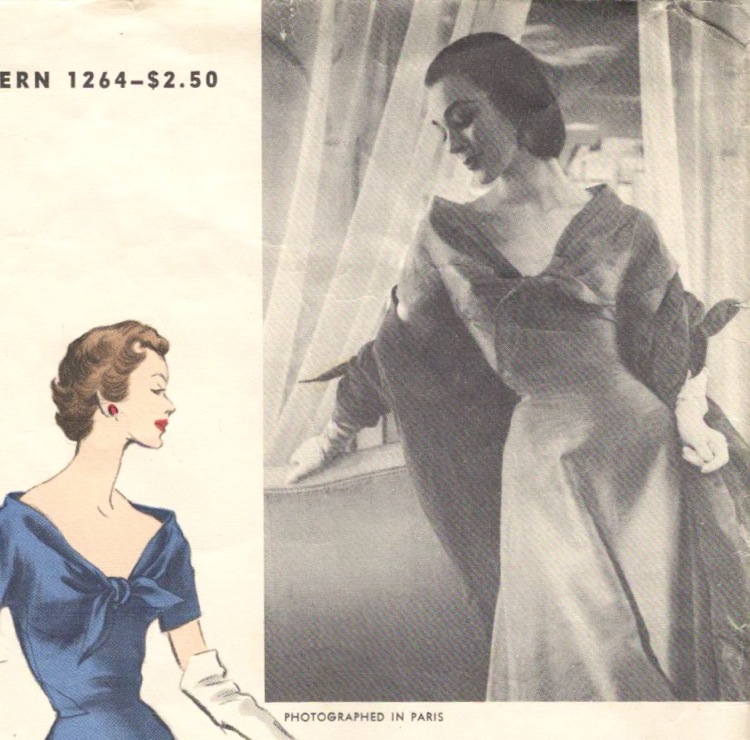
One envies Vogue’s rapid turnaround in those days: the woman who made Vogue 1450 when it came out was only a season behind. The distinction Roe makes between French and American figures is striking—I wonder whether it was really a question of sizing standards or taste in fit. It’s too bad the article is silent on the patterns’ graphic design, particularly the illustrations and photography. Since the pattern photos generally have the note, Photographed in Paris, they appear to show not the version adapted for home sewers, but the house’s original sample garment.
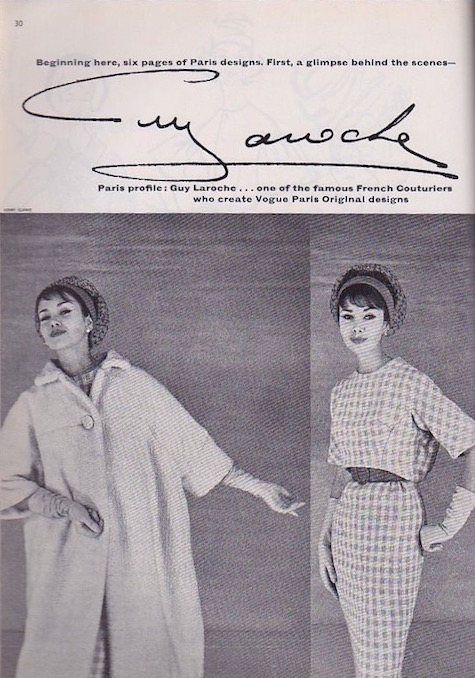
Update: Vogue 1450 was featured in the September 1959 issue of Vogue Pattern Book and Vogue magazine in May 1959. Perhaps Vogue gave an advance look at patterns?


 PatternVault
Leave a comment