I Heart Disco: Bob Mackie for McCall’s
June 30, 2012 § 2 Comments
Bob Mackie is known mainly for his work as a costume designer for performers like Carol Burnett, Diana Ross, and, of course, Cher.
In the late 1970s and early ’80s, McCall’s licensed a handful of Bob Mackie designs for stretch knits. The summer heat always makes me think of disco, so here’s a selection of disco-era Bob Mackie patterns:
McCall’s 6838 is a long-sleeved wrap dress in two lengths:
Here’s the envelope description: Misses’ dress – for stretch knits only. Long or short wrap-dress (without side seams), softly pleated into front waistline has shoulder gathers and long sleeves. Shaped sash is tacked to right side seam.
The second pattern in the series, McCall’s 6839, is a dress that’s high-necked in the front but has a deep cowl in the back:

McCall’s 6839 by Bob Mackie (1979) Image via eBay.
The envelope description reads: Misses’ dress – for stretch knits only. Low-backed dress in two lengths with shaped seaming has long sleeves, flared skirt, back zipper; softly draped bias collar snaps in back. Rhinestone trim is optional.
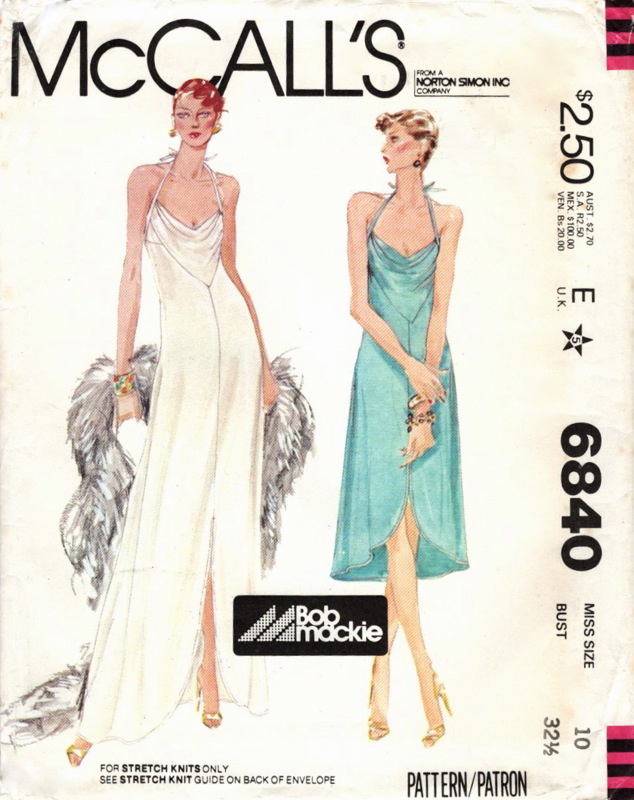
The third in the series, McCall’s 6840, is a halter dress with pleated cowl bodice inset and a shaped front hemline:
Here’s the envelope description: Misses’ dress – for stretch knits only. Back zippered halter dress in two lengths has flared skirt, shaped hemline with front slit; upper edge binding extends into ties. Loose, pleated cowl is included in side fronts only.
McCall’s 7134 includes a true disco jumpsuit—shaped at the waist with pleats and gathers, and with tapered legs designed to crush at the ankles. For extra fluidity, the pants and skirt have no side seams and are cut on the bias:
The envelope description reads: Misses dress and jumpsuit – for stretch knits only. Back zippered, fitted dress in two lengths and jumpsuit have slightly extended shoulders, low V-neckline, soft front waistline pleats and slight gathers in back. Dress has front slit with shaped hemline and pleated belt included in center back seam. Jumpsuit has purchased belt; length allows for crushing at ankles. Note: skirt and pants, cut on bias, have no side seams.
Interestingly, the McCall’s patterns pre-date Bob Mackie’s ready-to-wear line, which was launched in 1982. It’s difficult to find details on the designer’s work outside show business; Unmistakably Mackie, the catalogue from the Museum at FIT’s 1999 Mackie retrospective, focuses mainly on his costume work. The Bob Mackie patterns could be glitzed up or down depending on the sewer’s preference. I wonder whether they were designed exclusively for McCall’s?
Tennis, Anyone?
June 25, 2012 § 6 Comments
Wimbledon kicks off today. In honour of the world’s oldest tennis tournament, here’s a selection of patterns for playing the most fashionable sport.
Modern tennis fashion really got underway in the 1920s, when tennis became a popular leisure activity and couturiers like Chanel, Patou, and Vionnet designed tennis wear to meet the demand for fashionable luxury sportswear. (For more on ’20s tennis fashion see the Voguepedia article Tennis Dressing.)
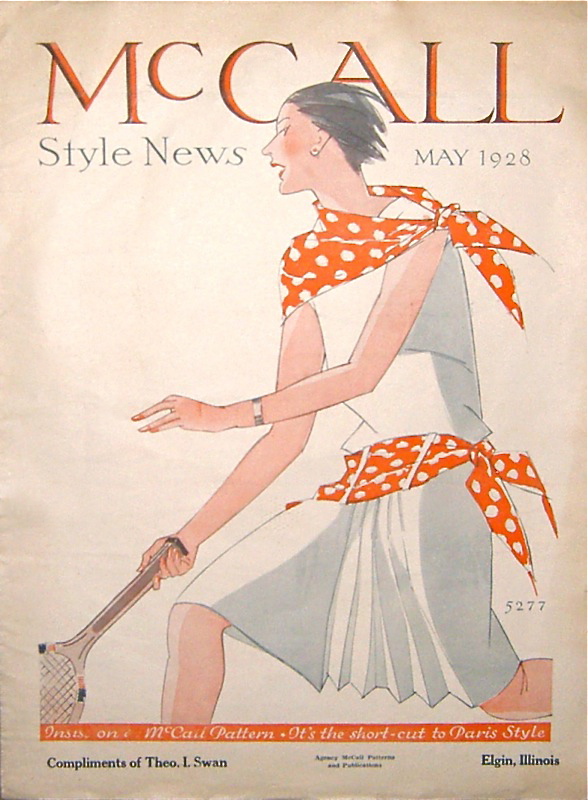
Typically, sewing patterns for tennis outfits show a woman holding a tennis racquet. The Deco cover of the McCall Style News shown at the top of this post portrays McCall 5277 as a dress for tennis, but the pattern envelope doesn’t advertise its suitability for sports. The illustration simply shows a day dress with the skirt pleated in front; the handkerchief collar and scarf girdle are optional:
In the early 1930s, sports dresses had lower hemlines, but could be worn unbuttoned in the back, like this McCall’s sports dress from 1933:
This pattern was illustrated on the cover of the Spring 1934 McCall Fashion Book:
(Catalogue image courtesy of Judy Yates of Vintage4me2.)
Playsuits and shorts became fashionable tennis wear after American tennis champion Alice Marble wore shorts to a professional match in 1932. These McCall’s sports separates include a tennis outfit with high-waisted shorts:
Lauren of Wearing History has made the McCall 9180 trousers; you can see a photo by clicking the pattern image.
The ‘masculine’ shorts trend continued into wartime, which also saw a return to the sports dress. This Advance tennis dress has a front zipper and inverted pleat, and includes panties for underneath:
In the postwar period tennis dresses or skirts, pleated or plain, became the standard tennis wear. The silhouettes reflected current trends, but with higher hemlines, as with this tennis dress with pleated skirt and cinched waist:

McCall 7170 (1948) Tennis dress and shorts. Image via eBay.
This Vogue tennis dress is a shorter version of the day dress also included in the pattern (check out the vintage camera):
Tennis hemlines are rising with these Vogue sports separates, which include a sleeveless blouse, shorts, and tennis skirt:
More perky pleats on this early 1960s tennis dress from McCall’s:
The popularity of tennis in the 1970s prompted the release of a wide variety of tennis patterns, for dresses, visors, and even racquet covers and other accessories. Vogue Patterns licensed tennis wear from Anne Klein, Penfold, and Anne Klein for Penfold (illustrated on the June 1976 news cover here). These Vogue Patterns magazine covers show an Anne Klein tennis outfit in action and Regine Jaffrey modelling a Vogue tennis shirt and visor:
Butterick licensed designs by women’s tennis champion Chris Evert, including this pattern for a tennis dress, briefs, and visor:
Butterick 4688 by Chrissie Evert for Puritan Fashions (c. 1977). Tennis dress, briefs, and visor. Image via the Vintage Patterns Wiki.
Karen Bjornson models this Penfold set consisting of a sleeveless tennis dress, t-shirt, shorts, and wrap miniskirt:

Vogue 1635 (c. 1977) Tennis dress, t-shirt, shorts, and wrap skirt. Model: Karen Bjornson. Image via the Vintage Patterns Wiki.
It’s interesting how the history of women’s tennis wear is a history of female athletes pushing the envelope: from May Sutton Bundy’s rolled-up sleeves, in 1905, and Suzanne Lenglen’s higher hemlines, to Alice Marble’s shorts and Serena Williams’ recent subversion (with hot pink briefs) of the rule of Wimbledon whites. (See a Guardian Wimbledon slideshow here and Vogue’s tennis slideshow here.) Women’s tennis fashions insist on femininity while offering an escape from modesty.